Dental Implant vs Dental Bridge in Dubai: Which Is Right for You?
Compare a dental implant and dental bridge for replacing a missing tooth in Dubai. Understand treatment steps, effects on neighbouring teeth, timing, costs, cleaning and suitability before choosing.
- Published
- 24 October 2026
- Reading time
- 7 min
- Written by
 Dr. Abdelrahman Ezzat
- Reviewed by
- Dr. Abdelrahman Ezzat
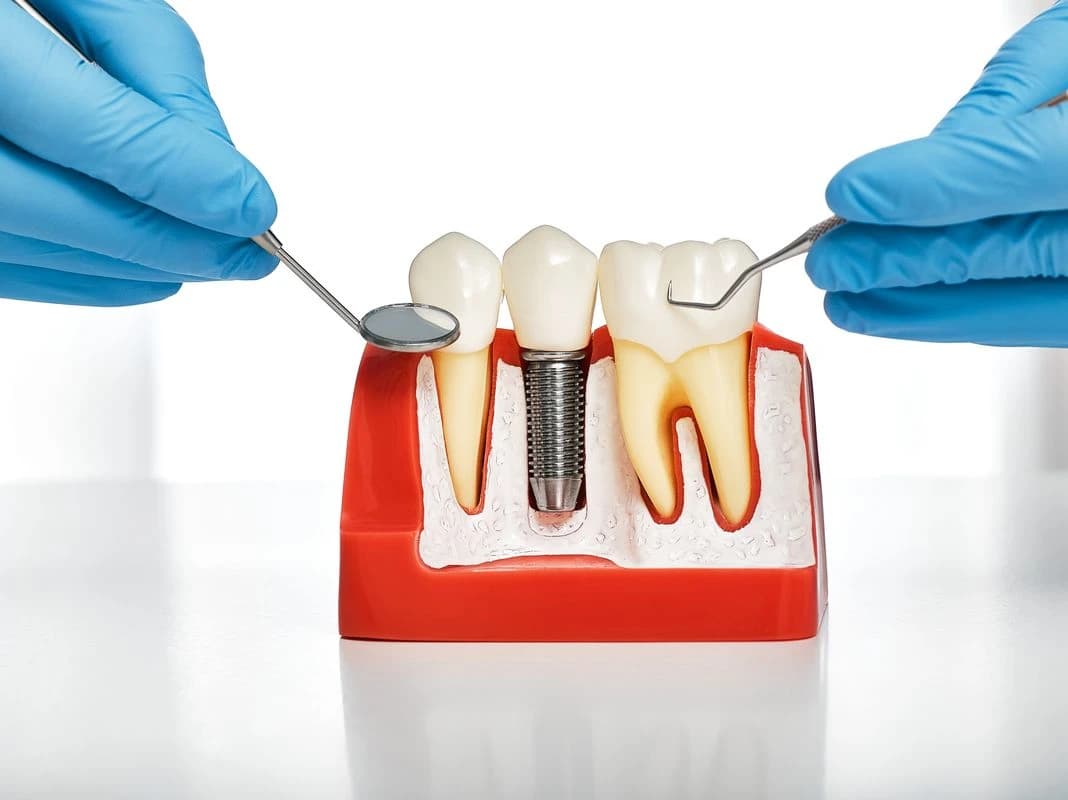
If you need to replace a missing tooth, the choice often comes down to a dental implant vs a dental bridge. Both can restore a fixed tooth, but they use different types of support. An implant is placed in the jawbone and supports its own crown. A conventional bridge fills the gap with an artificial tooth connected to crowns fitted over neighbouring teeth.
Neither option is automatically better for every patient. The right decision depends on the condition of the adjacent teeth, available bone, gum health, bite, medical history, treatment time, budget and your ability to maintain the result. This guide explains the main differences for patients comparing tooth-replacement options in Dubai.
What is a single-tooth dental implant?
A single-tooth dental implant usually consists of an implant fixture placed in the jawbone, an abutment and a custom crown. The implant acts as support for the replacement tooth without requiring crowns on the neighbouring teeth.
Treatment is surgical and normally includes consultation, imaging, implant placement, a healing phase and fitting the final crown. Some patients also require extraction, bone grafting or a temporary tooth. Suitability must be assessed individually.
What is a dental bridge?
A dental bridge replaces one or more missing teeth with an artificial tooth or teeth connected to supporting restorations. A conventional bridge commonly uses crowns fitted over teeth beside the gap. These teeth must be shaped to receive the crowns.
Another design, a resin-bonded or adhesive bridge, uses a wing bonded to the back of a neighbouring tooth and may require less preparation in selected cases, often in the front of the mouth. It is not suitable for every space or bite. The dentist determines the appropriate bridge design after examination.
Dental implant vs bridge: the key differences
Support
Implant: supported by an implant placed in the jawbone.
Bridge: supported by neighbouring natural teeth, existing implants or a combination specified in the treatment plan.
Effect on neighbouring teeth
Implant: a single implant crown can replace the missing tooth without preparing healthy adjacent teeth.
Conventional bridge: neighbouring supporting teeth are shaped for crowns. This may be a reasonable option when those teeth already need substantial restoration, but it is an important trade-off when they are intact.
Surgery
Implant: requires a surgical procedure and biological healing.
Bridge: a tooth-supported bridge usually avoids implant surgery, although tooth preparation and local anaesthesia are commonly required.
Treatment time
Implant: treatment may take several months because integration with the bone takes time. Extraction or grafting can extend the schedule.
Bridge: a conventional bridge can often be completed over fewer stages once the supporting teeth and gums are healthy, although laboratory fabrication still takes time.
Bone requirements
Implant: requires suitable supporting bone or a plan to manage a deficiency. Bone grafting may be discussed when the site lacks appropriate support.
Bridge: does not require an implant in the missing-tooth site, but the supporting teeth and their surrounding tissues must be suitable.
Cleaning
Implant: requires daily cleaning around the implant crown and gum margin, together with professional maintenance.
Bridge: requires cleaning beneath the artificial tooth and around the supporting crowns using suitable interdental aids. Both options can develop biological or mechanical problems when cleaning and reviews are neglected.
Repair and replacement
Implant: the crown, abutment or implant can develop complications, and components may require repair or replacement over time.
Bridge: the bridge may loosen, fracture or develop problems related to a supporting tooth. Repair options depend on the cause, material and condition of the supports.
When may a dental implant be preferred?
An implant may be considered when:
- the neighbouring teeth are healthy and avoiding their preparation is a priority;
- there is adequate bone, or a suitable grafting plan can be developed;
- gum health and oral hygiene are suitable;
- the patient accepts surgery and the healing timeline;
- medical and lifestyle factors do not make implant risk unacceptable; and
- a separately supported replacement tooth fits the overall bite and restorative plan.
An implant is not automatically appropriate because a tooth is missing. Read Am I Suitable for Dental Implants? for the main factors assessed during consultation.
When may a dental bridge be preferred?
A tooth-supported bridge may be considered when:
- the neighbouring teeth already have large restorations or need crowns;
- implant surgery is unsuitable or not preferred;
- the implant site has significant bone limitations and the patient does not want grafting;
- a shorter treatment pathway is important and clinically realistic;
- the supporting teeth, gums and bite can safely carry the bridge; or
- cost or other personal priorities favour a non-implant option.
A bridge should not be chosen without evaluating the supporting teeth. Decay, fractures, weak roots, gum disease or an unfavourable bite can affect whether those teeth are reliable supports.
Is an implant better for healthy neighbouring teeth?
A major potential advantage of a single implant is that it can replace the missing tooth without shaping intact adjacent teeth. This may support a conservative plan when those teeth are healthy. However, the implant site must still be suitable, and surgery, healing, risk and maintenance need to be considered.
If one or both neighbouring teeth already need crowns, a conventional bridge may address the missing tooth and the damaged supporting teeth within one restorative design. The dentist should explain how much healthy tooth structure would be removed and what could happen if a supporting tooth later develops a problem.
Which option looks more natural?
Both implant crowns and bridges can be designed to resemble natural teeth. The aesthetic result depends on tooth position, gum level, available space, shade, material, smile line, bone and soft-tissue architecture, and laboratory execution.
The front of the mouth can be especially demanding. An implant crown may require careful management of the gum profile, while a bridge must create a realistic tooth shape where the replacement meets the gum. No clinician should guarantee an identical result before assessing the site.
Which option is easier to clean?
Neither option is maintenance-free. A single implant crown is cleaned around its sides and gum margin, but the shape and contact areas must allow access. A bridge joins multiple teeth, so floss cannot pass vertically between the connected units; special floss, interdental brushes or other recommended aids may be needed beneath the replacement tooth.
Your dentist or hygienist should demonstrate cleaning before or after fitting. Choose an option you are realistically able to maintain every day.
Dental implant vs bridge cost in Dubai
The initial cost of a tooth-supported bridge may be lower than an implant in some cases, but this is not universal. A bridge quotation depends on the number of units, supporting teeth, materials, temporary restorations and any required treatment. Implant cost may include imaging, surgery, the implant fixture, abutment, crown, grafting and follow-up.
Ask for complete written quotations rather than comparing one advertised figure. Review what affects dental implant cost in Dubai and confirm which components and future maintenance are included for each option.
How long does each treatment last?
There is no guaranteed lifespan for an implant or bridge. Longevity depends on case selection, supporting tissues, restoration design, bite, oral hygiene, smoking, health, habits and professional maintenance. A bridge can be affected by decay or gum problems around its supporting teeth. An implant can be affected by inflammation around the implant or by mechanical complications.
Regular examinations help identify problems early. The visible crown or bridge may need repair or replacement even when the underlying support remains usable.
What if several teeth are missing?
The comparison changes when multiple teeth are missing. Options may include a longer tooth-supported bridge, individual implants, multiple-teeth implants, an implant-supported bridge or a removable partial denture. It is not always necessary or advisable to place one implant for every missing tooth.
How do you decide between an implant and a bridge?
- Assess the missing-tooth site. Examine the gums, space, bone and bite.
- Assess the neighbouring teeth. Determine whether they are healthy, already restored or need crowns.
- Review health and risk factors. Discuss medical history, medicines, smoking, gum disease and healing.
- Compare treatment burden. Consider surgery, tooth preparation, number of visits and healing time.
- Compare complete costs. Request written plans covering all stages and components.
- Plan maintenance. Understand how each option must be cleaned and reviewed.
A dental implant consultation should include discussion of reasonable non-implant alternatives. The decision should be based on your clinical findings and priorities, not on a universal claim that one treatment is always superior.
Compare tooth-replacement options in City Walk, Dubai
MID Dental Clinic is located at G08, Building 14, City Walk Residential, Al Wasl, Dubai. You can review the profile of Dr. Yasser Seif, Implantology Specialist and request a consultation to compare an implant, bridge and other appropriate options for your missing tooth.
- dental implant vs bridge
- implant or bridge Dubai
- replace missing tooth Dubai
- single tooth implant Dubai
- dental bridge Dubai
- زراعة الأسنان أم الجسر
- تعويض سن مفقود دبي
- جسر الأسنان في دبي
Next step
Does this apply to you?
Book a consultation and we will look at your case specifically, rather than in general.
Request an appointment
Common questions
Related questions.
City Walk, Dubai
Does this apply to you?
Book a consultation and we will look at your case specifically, rather than in general.